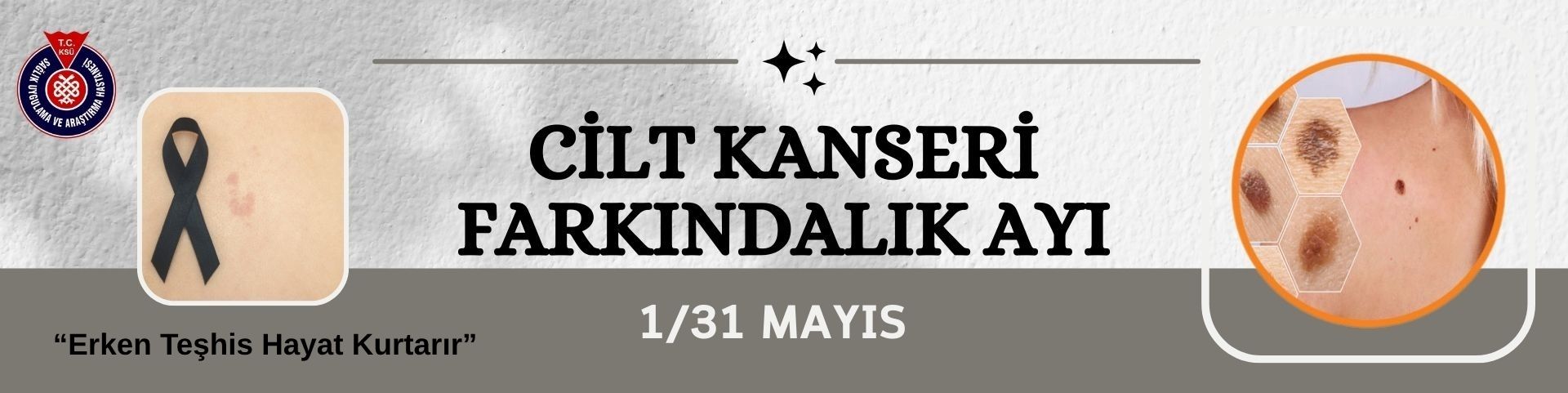
May has been designated as "Skin Cancer Awareness Month" to draw attention to skin cancer and raise public awareness. Through various events organized within this framework, the aim is to educate the public, particularly before increased sun exposure during the summer months, to identify risk factors, and to emphasize the importance of early detection.
Our skin is our largest organ, separating and protecting our body from the external environment. Skin cancer occurs when skin cells multiply uncontrollably. While not every skin change means cancer, suspicious changes noticed early on can help speed up the diagnostic process. Therefore, new formations on the skin or changes in existing moles should be carefully evaluated.
The main factors that increase the risk of developing skin cancer are:
Prolonged and intense sun exposure, exposure to artificial ultraviolet rays such as those from tanning beds, a family or personal history of skin cancer, fair skin that easily freckles and is prone to sunburn, and a weakened immune system are all risk factors.
Skin cancers are generally divided into two main groups.
1. Melanoma:
Melanom, cilde rengini veren melanosit hücrelerinin kontrolsüz büyümesiyle oluşan ve en tehlikeli cilt kanseri türü olarak kabul edilen bir hastalıktır. Genellikle ciltte görülmekle birlikte nadiren göz, ağız veya iç organlarda da ortaya çıkabilir. Melanomların yaklaşık %30’u mevcut benlerden gelişmektedir. Bu nedenle benlerde ortaya çıkan değişiklikler melanom açısından önemli uyarı işaretleri olabilir.
2. Non-Melanoma Skin Cancers:
Basal Cell Carcinoma (BCC)
It is the most common type of skin cancer. It usually grows slowly and is treatable if detected early. The following symptoms may appear on the skin:;
• Small bumps or swellings, sores that crust over or bleed
• Bright or translucent lesions, masses that grow over time
Squamous Cell Carcinoma (SCCc)
• Rough or thickened skin areas,
• Scabs that crust over and bleed
• Open wounds that don't heal
• Flaky red spots
How is skin cancer diagnosed?
The diagnostic process usually begins with a dermatological examination. A specialist examines the lesions on the skin. Dermatoscopy is used when necessary. A biopsy is performed for a definitive diagnosis. During the biopsy, a small tissue sample is taken from the lesion. Laboratory analysis can confirm the diagnosis of skin cancer. Imaging methods may be used in some cases to assess the spread of the disease.
How is skin cancer treated?
Surgical removal, radiotherapy, immunotherapy, targeted therapies, chemotherapy
What are the ways to protect against skin cancer?
A significant proportion of skin cancers are preventable with appropriate prevention methods. To this end:
• Avoid direct sunlight during peak sun hours (10:00–16:00).
• Broad-spectrum sunscreen with a high protection factor should be used.
• Eyes and the area around the eyes should be protected from UV rays by wearing sunglasses.
• Hats and protective clothing that covers as much of the skin as possible should be preferred.
• Harmful chemicals and the use of tanning beds should be avoided.
• The skin should be checked regularly.
Self-Skin Examination
• A full-length mirror should be used in a well-lit environment.
• The entire body should be carefully examined, including the face, neck, torso, arms, and legs.
• All areas should be examined, including the palms of the hands, soles of the feet, scalp, ears, nails, and back.
• For hard-to-see areas, a hand mirror should be used or assistance should be sought from someone nearby.
Signs to Look Out For During Self-Examination of Your Skin:
New, unusual moles or spots on the skin, non-healing sores, crusting or bleeding, itching, tenderness or pain, and changes in the shape, color or size of moles should be noted.
If you notice anything new, changed, or unusual on your skin during a self-examination, seek medical attention immediately. Remember! Skin cancer is one of the most common types of cancer.